Will AI really replace programmers? Not the good ones, necessarily
AI already writes code, tests, and documentation, so the question about the future of programmers keeps coming back like a boomerang. The thing is, the real issue is not “will they disappear?” but “which ones will be needed most.” Find out what AI automates, where humans still win, and how to prepare wisely for the change.
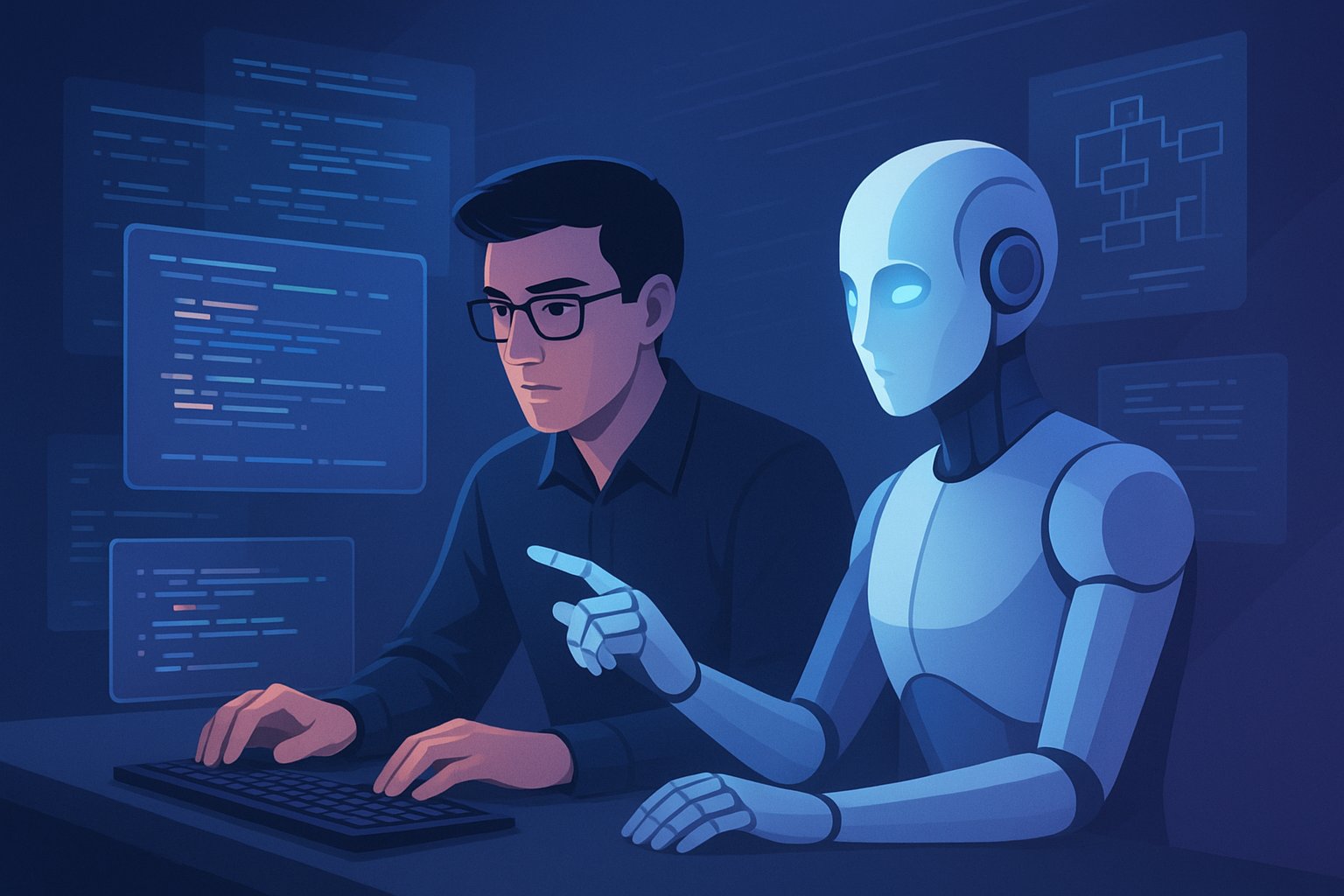
AI that writes code is no longer a curiosity. Today it can add an endpoint, generate tests, explain an error from logs, and suggest a refactor. For some, that is an exciting speed boost. For others: a small existential crisis in VS Code.
The question “will AI replace programmers?” is, however, framed poorly. A more accurate question is: which programming tasks will become cheaper, faster, and more automated, and which will still require a human. Because the market rarely works in a binary way. This is not about one big “replace developer” button, but about a shift in the value of work.
This matters not only for developers themselves. It also affects business owners trying to understand whether they can “replace a team with AI,” as well as everyday technology users who see increasingly smart tools and wonder where all this is heading.
Where does the fear of replacement come from?
Because AI does things that until recently were considered very “human” in programming:
- completes code based on context,
- translates an unfamiliar repository,
- generates SQL, regexes, and scripts,
- creates unit tests,
- suggests architecture,
- detects obvious bugs,
- writes documentation and comments.
If someone looks at a programmer only as a person who “types code,” then it is indeed easy to conclude that the matter is settled. But professional programming has never been only about writing lines. Code is the final artifact. Value is created earlier: by understanding the problem, negotiating requirements, making trade-offs, ensuring security, maintainability, and business sense.
AI is very good at what is:
- repetitive,
- well described,
- based on known patterns,
- easy to verify,
- local rather than systemic.
And that is exactly where the difference begins between “writing something that works” and “building a solution that can be maintained for three years without the team and client crying.”
What AI already automates really well today
There is no point pretending that little has changed. A lot has changed.
1. Rapid prototyping
Have an idea for a simple app, admin panel, API integration, or data parser? AI can shorten the time from idea to working demo from days to hours. For startups and small companies, that is a huge difference.
2. Boilerplate and repetitive code
CRUDs, validations, standard endpoints, migrations, configurations, test templates. All of that is fertile ground for models. The programmer does not disappear, but stops manually producing things that are just variations on the same theme.
3. First-level debugging
AI can be surprisingly effective at analyzing stack traces, suggesting causes of errors, or pointing out type mismatches. It is not always right, but it often shortens the path to a solution.
4. Onboarding to unfamiliar code
New project, 40,000 lines, no documentation, and the author has been working elsewhere for half a year. Classic. AI tools can summarize repository structure and explain dependencies faster than the traditional “read everything in order.”
5. Writing around the code
Documentation, changelogs, pull request descriptions, technical comments, naming suggestions. Small things, perhaps, but at team scale they save a lot of time.
Conclusion? Yes, part of a programmer’s work is becoming cheaper and faster. That is true. But that does not yet mean the profession is disappearing.
What AI still does not do well
This is where the less flashy but more important part of the conversation begins.
Understanding vague requirements
A client says: “the system should be simple, secure, and scalable.” Sounds reasonable, but technically it means very little. Someone has to ask:
- for how many users,
- what the failure scenarios are,
- what “secure” means in this specific context,
- where the budget constraints are,
- what is truly the priority.
AI can help formulate questions, but it does not take responsibility for asking and interpreting them.
Making trade-offs
In real projects, you almost never choose the ideal solution. You choose the solution that is good enough under the given constraints. Faster or cleaner? Cheaper now or more stable in a year? Monolith or microservices? Build it yourself or use a ready-made service?
These are not just technical decisions. They are business, organizational, and sometimes political decisions. AI can generate a pros-and-cons table. A human makes the final call.
Responsibility for security and reliability
A model may write code that looks correct but contains subtle flaws: authorization bugs, secret-handling issues, vulnerabilities in dependencies, risky assumptions in data validation. In production systems, that is not a detail. It can be an expensive disaster.
Systems thinking
AI works well locally: a function, a module, an endpoint. It struggles more when it has to predict the impact of changes on the whole ecosystem: monitoring, infrastructure costs, regulatory compliance, deployment process, user experience, support workload, future product growth.
Working with people
This may sound banal, but many projects fail not because of algorithms, but because of communication. A programmer who can talk to business, design, security, and operations is much harder to replace than someone who only writes code quickly.
Who is most at risk today
Not “programmers” as a whole group, but specific work profiles.
The most exposed to automation pressure are tasks performed according to known patterns, without deeper understanding of the goal. If someone has spent years basing their value mainly on producing standard code quickly, AI really does lower the market price of that kind of work.
This applies especially to:
- very simple junior production tasks,
- work based on copying patterns without understanding,
- assignments like “make a simple website, form, panel, integration,”
- parts of outsourcing where speed and cost matter most.
That does not mean juniors are “doomed.” Quite the opposite. The entry path is just changing. There will be less paid learning on simple tasks and more expectation that a candidate can work with AI, verify the output, and understand the broader context.
Who will benefit the most
The biggest winners will be programmers who treat AI as an amplifier, not an opponent.
People who can:
- define problems precisely,
- break complex tasks into stages,
- assess the quality of generated code,
- design architecture, not just implementation,
- combine software engineering with security and operations,
- integrate AI models with real business systems.
That last point is key. Because the market no longer needs only people who “know how to use a model.” It needs people who can build solid, secure, and useful systems around AI.
The programmer of the future: less typing, more decisions
The most likely scenario is not that AI takes everyone’s jobs. It is more that one good programmer supported by AI will do more than an entire small team used to do on simple tasks. That will increase productivity, but it will also raise the bar.
In practice, the importance of skills that were once treated as a “soft add-on” or “something for seniors” is growing:
- requirements analysis,
- system design,
- code review,
- security,
- observability and maintenance,
- communication with business,
- responsibility for outcomes.
Code will still matter. But the mere fact that someone can write it is no longer enough as a competitive advantage.
What about business owners? Can you just replace a team with AI?
Short answer: usually not.
Longer answer: you can reduce the cost of certain tasks, speed up development, and change the team structure. But companies that think of AI only as a way to cut headcount often fall into the same trap: they confuse a quick prototype with a working product.
A system that works in a demo does not have to be:
- secure,
- scalable,
- legally compliant,
- easy to maintain,
- resilient to user errors,
- ready for integrations and growth.
If a business deploys AI without people who understand architecture and risks, the initial savings can easily turn into costs after a few months. Sometimes very concrete ones, measured in outages, complaints, and late-night calls.
Where AI really changes the rules of the game
The most interesting change is not that a model writes a function faster. It is that a new software layer is emerging: systems that work with AI agents, language models, RAG, and external tools.
That raises very practical questions:
- how to safely expose tools to models,
- how to control permissions and data access,
- how to design interfaces for agents,
- how to log and monitor AI actions,
- how to limit abuse risks,
- how to deploy such systems in production.
And this is exactly where it becomes clear that the future of programming does not end at “can the model write code.” It shifts toward designing infrastructure and collaboration protocols between AI and the rest of the system.
If you want to be on the right side of change, learn to build for AI
For experienced developers, a very sensible direction is to go deeper into MCP servers and tools for agents. This is not a trendy gimmick, but an area where architecture, security, integrations, and practical use of models come together.
A good example is the course Best practices for writing MCP servers. It is for people who do not want to stop at the level of “AI will generate something,” but want to know how to design, implement, secure, and operationalize MCP servers for AI agents, LLM applications, and RAG systems.
Why does this make sense right now?
- because companies increasingly need not the model itself, but secure tools around it,
- because the advantage is shifting from writing simple code to building reliable integrations,
- because experienced programmers can move into a higher-value area than ordinary boilerplate,
- because business owners gain a better understanding of how to deploy AI without chaos and risk.
If someone asks how not to be “replaced by AI,” one of the more honest answers is: learn to build things that AI itself will not responsibly deploy to production.
Should ordinary people care about this too?
Yes, even if they do not write code.
Because this topic is not only about the IT industry. When AI enters products, banking, education, medicine, customer service, or public administration, we all become users of systems that make decisions or co-decide how processes unfold.
It is worth understanding at least that:
- AI is not magically “objective,”
- it can be wrong in a very convincing way,
- it requires supervision, testing, and constraints,
- the quality of deployment depends on the people who designed the system.
It is a bit like autopilot in an airplane. The fact that it exists does not mean the pilot is unnecessary. It means the pilot’s role becomes even more responsible when something goes off plan.
The most honest answer to the title question
Will AI really replace programmers?
Not all of them. Not entirely. But it will definitely change what programmers are paid for.
Some mechanical work will disappear. The value of “writing code” as a standalone activity will fall. The importance of understanding systems, security, integrations, architectural decisions, and the ability to work with AI as a partner will rise.
Those who base their value on predictable code production will struggle more. Those who can think more broadly — about product, risk, quality, and deployment — will do better.
This is not the end of programming. It is rather the end of a certain comfortable idea of programming as a profession that mainly consists of turning specifications into code.
And maybe that is a good thing. Because the best parts of this job were never about typing on a keyboard. They were about solving problems that nobody had properly named before.
And with that, AI still has an uphill battle, at least for now.